How CVE-2026-89426 Turns a Subscriber Into an Administrator
The entire attack runs inside one Gravity Forms front-end submission, available to any authenticated user when the feed maps a user role field. The gform_pre_submission hook — registered only for non-admin requests — fires the payment processor, which synchronously marks a zero-amount submission SUCCESS; no real payment is required. The SUCCESS branch fulfills the order in the same request and calls maybe_update_user_role(), which reads the submitted value of the mapped form field and hands it straight to WP_User::set_role(). There is no capability check, no allowlist of permitted roles, no comparison against the field's configured choices, and no exclusion of privileged roles. The target is the submitter's own account — not another user's session. Choosing 'administrator' delivers complete site control (CVSS 8.8: C:H/I:H/A:H).
BitFire FREE Bot Protection Stops the Attack Before WordPress Runs
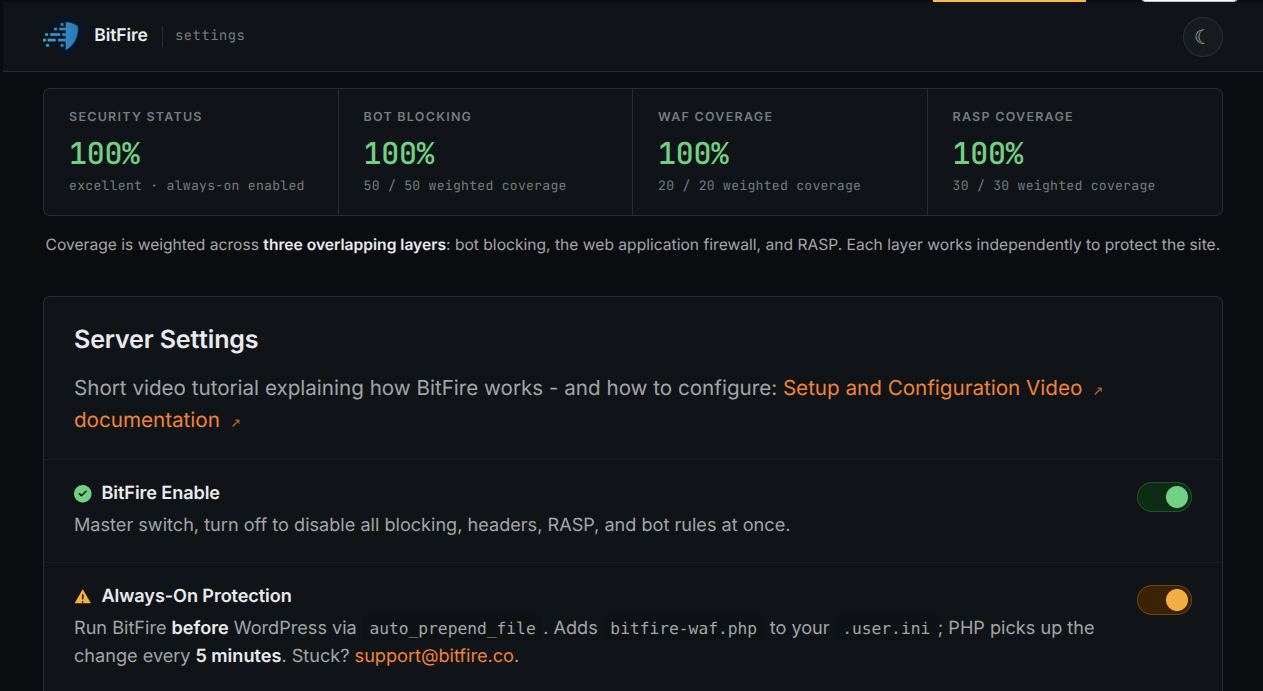
CVE-2026-89426 has exactly one delivery vehicle: an automated front-end form POST into gform_pre_submission. That is precisely the traffic BitFire FREE Bot Protection classifies and stops. Clients presenting as browsers must pass lightweight JavaScript browser verification before forms are processed — scripted exploit submissions typically fail — and known attack and scanning tools are blocked outright. The result: the exploit's only delivery step is terminated before vulnerable Knit Pay code ever executes. This request-layer protection ships in BitFire FREE for eligible non-commercial websites; no PRO upgrade is required. The limitation is stated plainly: an explicitly allowlisted bot or a real, successfully verified browser session is not categorically stopped — which is exactly why the runtime layer below exists.
BitFire PRO RASP Blocks the Unauthorized Administrator Grant
If an allowed or verified client still slips through, BitFire PRO RASP kills the exploit at the protected operation itself. The chain's final step is pure administrator impersonation: an ordinary Subscriber account claims the administrator role — and every associated capability — without any valid administrator credential evidence. BitFire PRO's administrator credential-evidence guard requires real authentication evidence for sensitive administrator actions and blocks that grant. The role write is denied, the attacker stays a Subscriber, and the site is never compromised. RASP does not sanitize the original input, and it does not need to recognize CVE-2026-89426 — it enforces authorization at the moment privileged identity would be assigned, closing this chain regardless of how the request arrived.
If Your Site Was Affected, Investigate for Persistence
Knit Pay 9.6.2.0 fixes the defect with layered server-side validation: is_allowed_user_role() rejects empty values, non-existent roles, and privileged roles through is_privileged_role() — 'administrator' plus any role holding manage_options, edit_users, promote_users, or similar capabilities — and even safe assignments must match the field's admin-configured default or choices. Update immediately. Patching closes the known path; it does not remove a compromise that already succeeded. If your site ran 9.6.1.0 or earlier, run BitFire Threat Hunter and sweep for the residue of a successful escalation: backdoor administrator accounts, hidden database triggers, long-running PHP processes, and droppers that can restore malware or reinfect the site. Remove every persistence mechanism it finds and rotate administrator credentials — assume nothing is clean until verified.
Deploy BitFire, Close the Gap for Good
CVE-2026-89426 is a clean privilege-escalation chain: one automated form submission, a zero-amount payment marked SUCCESS, and an unvalidated role value that hands a Subscriber the keys to the site. BitFire breaks that chain twice — BitFire FREE Bot Protection stops the automated form delivery before WordPress runs, and BitFire PRO RASP blocks the unauthorized administrator grant at the protected operation. Patch to Knit Pay 9.6.2.0 now, put BitFire in front of your site, and let Threat Hunter confirm no persistence remains. Start protecting your WordPress site with BitFire today.