What the CVE Entry Establishes
The disclosure states that Ninja Forms 3.15.3 stores a value submitted through a non-RTE textarea field by an anonymous visitor and later renders that stored value in the legacy submission editor without safe HTML encoding. Because the value is not encoded for the HTML context it lands in, an attacker can break out of the textarea markup and store script alongside the legitimate field content. Execution is triggered when an Administrator opens the direct submission URL the attacker already knows, and the injected script then runs in the WordPress admin origin. Version 3.15.4 fixes the flaw. The brief does not name a submission endpoint, request format, or patch implementation, and this article does not assume them.
BitFire FREE Blocks the Script Before It Is Stored
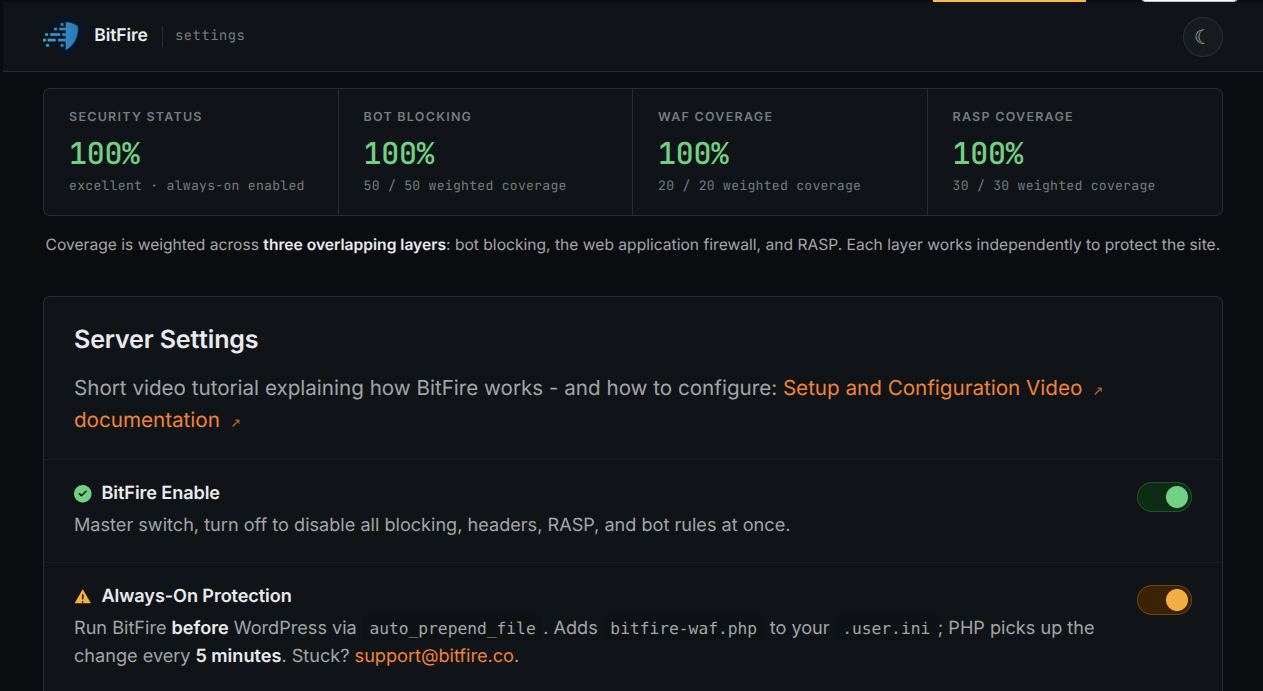
BitFire's request-layer controls act on the two facts the disclosure does establish: the payload arrives as submitted form data, and it is a malicious JavaScript injection. The BitFire FREE WAF inspects URLs, query strings, form fields, and POST bodies before WordPress hands the request to Ninja Forms, and its cross-site scripting detection blocks recognizable script payloads, including common evasion patterns, before the value is written to the submission store. Bot Protection adds a second barrier: unknown or restricted bots cannot submit forms at all, clients presenting as browsers must pass lightweight JavaScript verification first, and known attack tools are blocked outright. Automated delivery of the stored payload is denied before the vulnerable code runs; a verified human browser is not blocked.
BitFire PRO RASP Contains Admin-Origin Fallout
Stored cross-site scripting in the admin origin is valuable to attackers because the running script can drive privileged requests. BitFire PRO RASP enforces authorization on the protected operations those requests attempt, without needing a CVE-specific signature. If the injected script's follow-on activity tries to create a backdoor administrator, promote a user, make protected database changes, write PHP, install plugin payloads, or connect outbound to known malicious command-and-control infrastructure, PRO RASP denies the unauthorized result. The boundary is worth stating plainly: RASP does not sanitize the stored textarea value, does not repair the missing encoding, and acts on privileged outcomes rather than on the script tag itself. It is containment for the damage stage, layered behind the FREE request-layer blocks.
If Your Site Was Affected, Investigate for Persistence.
Update Ninja Forms to 3.15.4 immediately; every release through 3.15.3 is vulnerable. Patching closes the stored-script path but does not undo an earlier exploitation, and a form builder on more than 500,000 sites is an attractive target for campaigns that ran before publication. Administrators who saw unexpected submissions or unexplained admin activity should investigate before declaring the site clean: BitFire Threat Hunter checks for backdoor WordPress administrator accounts, hidden database triggers, WordPress and server cron persistence, must-use plugin and startup-chain modifications, suspicious database content, long-running PHP processes, and droppers that can reinfect the site. Remove discovered persistence and rotate relevant credentials, including administrator passwords and application passwords.
Patch, Then Keep BitFire Layered On
CVE-2026-94504 turns an anonymous form field into admin-origin script execution, and it is fixed in Ninja Forms 3.15.4 — update now. Install or enable BitFire FREE so the WAF inspects submitted form data for malicious JavaScript and Bot Protection stops unverified automated submissions, and add BitFire PRO RASP to deny unauthorized administrator, database, file, and command-and-control outcomes at runtime. If the site ran an affected version, run Threat Hunter to verify no persistence survives the patch. Layered protection plus prompt patching closes this path completely.