CVE-2024-1981 Exposes WPvivid's Staging Database Workflow
WPvivid provides backup, migration, restore, and staging features to approximately 900,000 WordPress installations. CVE-2024-1981 identifies version 0.9.68 as vulnerable and carries a critical CVSS score of 9.8. An attacker does not need a WordPress account or user interaction: a crafted POST to WordPress's public AJAX endpoint can start the staging process with an attacker-selected `table_prefix`. Because that prefix reaches database statements as SQL structure rather than a safely bound data value, an attacker may alter the intended queries and extract sensitive database information. The precise records exposed or changed depend on the payload and database privileges, so those are possible impacts rather than guaranteed compromise of every site record.
A Public AJAX Hook Carries table_prefix Into SQL
In WPvivid 0.9.68, `WPvivid_Staging::load_ajax()` registers both `wpvividstg_start_staging_free` and `wpvividstg_get_staging_progress_free` with WordPress's `wp_ajax_nopriv_` hooks. Those hooks deliberately dispatch requests from visitors who are not logged in. `start_staging()` reads `table_prefix` directly from `$_POST`, stores it as the staging task's `new_prefix`, and starts copying the site and its database. The database-copy component concatenates that prefix with table names and places the resulting identifiers into statements such as `CREATE TABLE`, `UPDATE`, `DROP TABLE`, and `RENAME TABLE`. Prepared placeholders are designed for data values, not arbitrary SQL identifiers; accepting a caller-selected prefix without a strict identifier allowlist lets SQL metacharacters change the resulting statement.
Version 0.9.69 Removes Unauthenticated Access to the Workflow
The research advisory identifies 0.9.69 as the fixed release, and an exact comparison of the WordPress.org 0.9.68 and 0.9.69 packages confirms the security-relevant change. Version 0.9.69 changes the active hook names from `wp_ajax_nopriv_wpvividstg_start_staging_free` and `wp_ajax_nopriv_wpvividstg_get_staging_progress_free` to their `wp_ajax_` equivalents. Removing the `_nopriv_` portion from each active registration makes WordPress dispatch those endpoints only for authenticated requests. The correction closes the exposed route rather than attempting to make hostile table-prefix syntax safe. The corrected-behavior excerpt presents that hook-name change directly as an abridged reconstruction instead of showing commented-out registrations.
BitFire Blocks Automated Delivery and the SQL Injection Payload
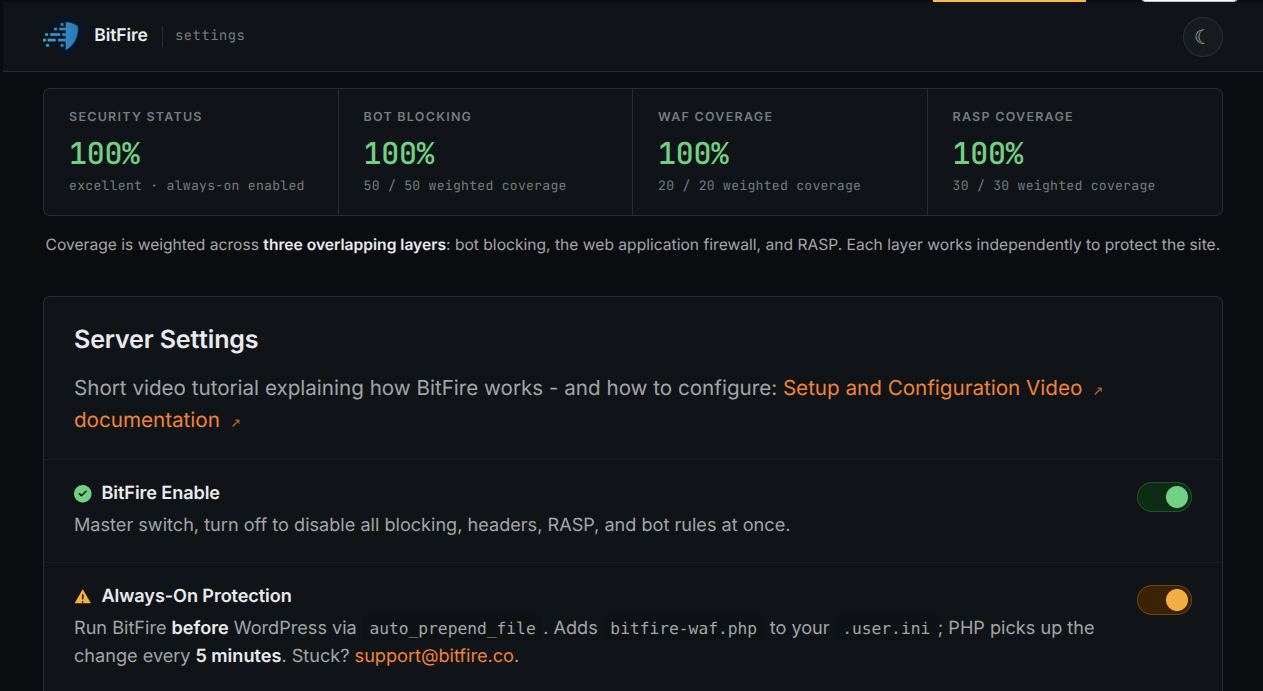
Exploitation requires an attacker-controlled POST containing staging parameters such as `action` and `table_prefix`. BitFire bot protection detects an unknown automated client or impersonated browser sending unknown GET or POST parameters and can reject it before WordPress routes the request to WPvivid. Independently, BitFire WAF analyzes the `table_prefix` value for SQL injection behavior, including malicious SQL syntax and evasion patterns. When that rule matches, the WAF denies the request before `start_staging()` stores the hostile prefix or the staging task assembles a database statement. These request controls are behavior-based and active before a CVE-specific signature exists; they do not claim to block legitimate explicitly allowed integrations.
BitFire PRO RASP Protects the Database Outcome
BitFire PRO RASP provides a separate runtime boundary for exploit paths that reach application code despite request filtering. Its database policies prevent unauthorized access to sensitive data and unauthorized creation of WordPress administrator accounts. If an injected staging query attempts either outcome, RASP follows execution to the protected database operation and denies it even though the plugin accepted and routed the request incorrectly. This outcome-based control does not replace SQL injection filtering and does not imply that every injected statement creates an administrator; it limits the high-impact results that a successful injection may pursue from any request vector.
Conclusion: Staging Operations Need Independent Access Controls
Administrators can verify the installed WPvivid release and review web, database, staging, and BitFire events for unexpected `wpvividstg_start_staging_free` requests, unusual table prefixes, or unrecognized staging tasks. CVE-2024-1981 demonstrates why site administrators need a security solution with built-in access controls and zero-day protection when a plugin exposes a privileged database workflow. BitFire's bot and SQLi controls can stop the malicious request before WPvivid runs, while BitFire PRO RASP independently protects sensitive reads and administrator creation at the operation where they must succeed—even before a vulnerability-specific response has been written.