CVE-2026-14488 vulnerability and BitFire protection

How BitFire RASP Stops CVE-2026-14488 Unauthorized Post Deletion

WordPress vulnerability research

BitFire RASP blocks CVE-2026-14488 at the database layer by preventing users without the required WordPress capabilities from deleting posts and pages.

Unauthenticated Critical Severity Arbitrary Content Deletion Missing Authorization
BitFire · Vulnerability advisoryResearch published
AdvisoryCVE-2026-14488
ComponentMeta Box AIO: MB Frontend Submission
Relevant sourceMB Frontend Submission request dispatcher: handle_request() and check_ajax()
Executive summary

What WordPress administrators need to know

CVE-2026-14488 is a critical missing-authorization vulnerability in the MB Frontend Submission extension bundled with Meta Box AIO. In versions up to and including 3.8.0, an unauthenticated attacker can send the `mbfs_delete` action through a page containing a frontend submission form and choose the post ID with `rwmb_frontend_field_object_id`. The vulnerable request path does not verify ownership or capabilities, while its nonce check is skipped for `template_redirect` requests. BitFire PRO RASP protects the database operation itself: users without `edit_posts` cannot delete content, and users without `edit_others_posts` cannot delete content belonging to someone else.

At a glance

Key facts

  • Meta Box AIO versions up to and including 3.8.0 are vulnerable
  • No WordPress account is required to send the deletion request
  • The attack works through any page hosting a frontend submission form
  • An attacker controls the target through `rwmb_frontend_field_object_id`
  • BitFire PRO RASP enforces WordPress content permissions at the database layer
01
Vulnerability overview

Understand the exposure

The affected component, attack path, and practical risk for WordPress websites.

Affected componentMeta Box AIO: MB Frontend Submission
Potential reach600,000+ installations
Attack techniquemissing authorization
Published2026-07-28
BitFire RASP does not trust a delete action simply because vulnerable plugin code requested it; the user must have permission to edit that content before the database change is allowed.
02
Technical analysis

How the vulnerability works

Research details, affected versions, exploitation behavior, and remediation guidance.

CVE-2026-14488 Exposes a Public Content-Deletion Path

MB Frontend Submission lets WordPress sites publish forms that create and edit content from the frontend. Its request dispatcher runs on `template_redirect` when one of those forms is present. Through version 3.8.0, `handle_request()` routes the `mbfs_delete` action without first checking whether the visitor is logged in, owns the target post, or has a capability that permits deletion. The result is a network-accessible integrity and availability flaw with a 9.1 CVSS score: an anonymous visitor can cause legitimate posts and pages to be removed.

Why the Nonce Check Does Not Stop the Attack

The extension has nonce verification in `check_ajax()`, but that check is conditional. It runs only when `is_ajax()` returns true. A request dispatched through `template_redirect` is not an AJAX request, so `is_ajax()` is false and the function returns before verifying a nonce. The attacker can therefore reach the same delete action over the frontend route without satisfying the security check that protects the AJAX route. This is an authorization failure as well as a request-validation bypass: a nonce can help establish request intent, but it cannot replace an ownership or capability check.

The Attacker Selects Any Post or Page ID

The vulnerable handler reads the target from the `rwmb_frontend_field_object_id` GET parameter. An attacker can place the ID of a post or page into that parameter and submit `mbfs_delete` against any page that contains a frontend submission form. The attack is not limited to content created through that form, and it still reaches the deletion path when the form's `allow_delete` option is disabled. Because WordPress object IDs are numeric and commonly discoverable, identifying valuable targets does not present a meaningful barrier.

BitFire RASP Enforces Authorization at the Database Layer

BitFire PRO RASP protects the operation that matters rather than relying on the vulnerable route to make the right decision. When PHP attempts to delete a WordPress post or page, RASP carries the request's identity and authorization context to the database layer. It denies content deletion when the requester lacks `edit_posts`, and it requires `edit_others_posts` before a user can alter content owned by another account. An unauthenticated attacker has neither capability, so the destructive database operation is blocked even though Meta Box AIO routed the request. This also limits damage if another plugin exposes a different path to the same sensitive action.

Why Site Administrators Need Runtime Database Protection

Meta Box AIO 3.9.0 includes the vendor's fix for missing authorization on frontend post deletion, but a vendor fix can address only vulnerabilities that have already been discovered. Site administrators need a security solution that continues protecting sensitive operations when a plugin contains an unknown authorization flaw or an alternate request path bypasses its checks. BitFire PRO RASP provides that independent control at the database layer. Administrators should also review BitFire events, access logs, the WordPress Trash, recent database changes, and editorial activity for unexpected deletions involving frontend submission forms.

Conclusion: Protect Sensitive WordPress Database Operations

CVE-2026-14488 demonstrates why request checks inside a plugin are not a sufficient final security boundary. One alternate dispatcher skipped the nonce, and the delete action lacked the capability and ownership checks needed to protect site content. Site administrators need a security solution that remains effective when application code makes the wrong authorization decision. BitFire PRO RASP adds that boundary at the database layer, requiring every attempted post or page deletion to match the requester's real WordPress permissions and stopping unauthorized content changes even when vulnerable plugin code allows the request.


03
Source review

Vulnerable and fixed code

The relevant source is located in MB Frontend Submission request dispatcher: handle_request() and check_ajax().

BeforeVulnerable behavior
// Vulnerable request flow, abridged.
// template_redirect reaches this dispatcher outside AJAX.
$this->check_ajax();

if ( 'mbfs_delete' === $action ) {
    $post_id = $_GET['rwmb_frontend_field_object_id'];
    wp_delete_post( $post_id );
}

private function check_ajax() {
    if ( ! $this->is_ajax() ) {
        return; // Nonce verification is skipped.
    }
    check_ajax_referer( 'mbfs' );
}
AfterCorrected behavior
// Required corrected behavior, abridged.
// Deletion must be authorized regardless of request transport.
$post_id = absint( $_GET['rwmb_frontend_field_object_id'] ?? 0 );

if ( ! $allow_delete || ! is_user_logged_in() ) {
    return;
}
if ( ! current_user_can( 'delete_post', $post_id ) ) {
    return;
}

// Verify the deletion nonce for template_redirect and AJAX requests.
$this->check_delete_nonce();
wp_delete_post( $post_id );
04
Zero-day protection

Protection from the first exploit request

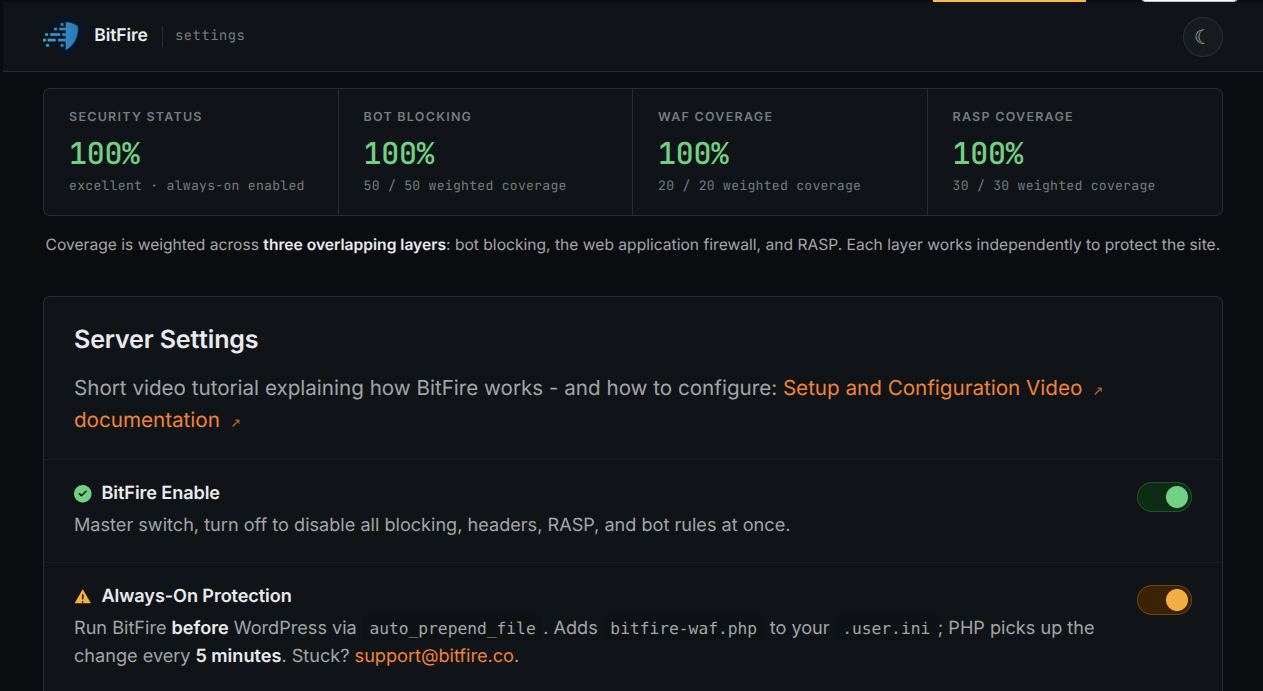
BitFire protects WordPress servers on day zero—before a vulnerability is publicly known and before other vendors have time to develop signatures or patches.

01 · VerifyStop unknown clients

Bot controls and browser verification stop untrusted automated clients before previously unknown exploit code reaches WordPress.

02 · DetectBlock malicious behavior

General WAF protections identify dangerous request behavior and hostile payloads without waiting for a vulnerability-specific signature.

03 · PreventContain attacks at runtime

RASP follows execution inside PHP and prevents unauthorized changes to protected files, accounts, and database content.

BitFire · WordPress protectionZero-day ready
BitFire zero-day WordPress vulnerability protection
BitFire combines verified-client controls, behavior-based WAF detection, and runtime RASP enforcement to protect WordPress before an exploit has a name, CVE, signature, or vendor patch.
About the author

Cory Marsh

Cory has more than 20 years of internet security experience and is a lead developer on the BitFire project.

Read BitFire security research →
Protect your WordPress website

Add protection before the next exploit arrives.

BitFire combines bot controls, request inspection, malware detection, and runtime protection in one WordPress security platform.

Protect my site free →